
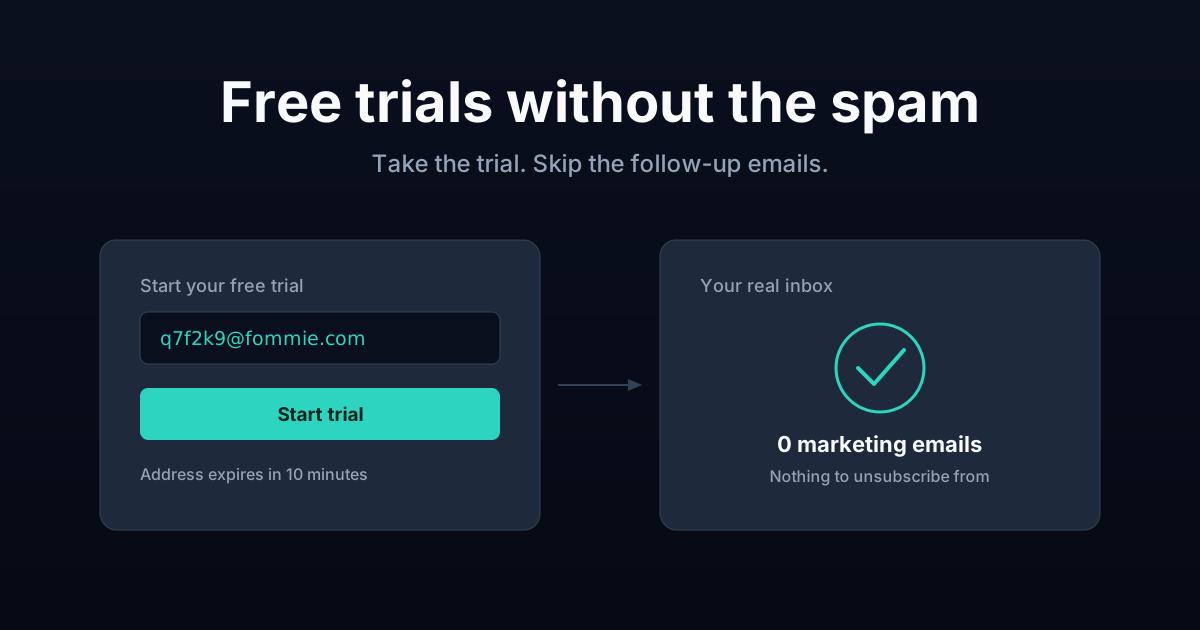
A free trial costs you nothing in money and a fair amount in email. The fix takes about ten seconds: generate a disposable address, use it for the signup, click the confirmation link, start the trial. Your real inbox never enters the company's database, so the onboarding sequence, the upgrade nudges, and the win-back campaign eighteen months from now have nowhere to land.
One thing a disposable address will not do is stop a charge. If you handed over a card, the card stays on file and the trial still converts on schedule. Those are two separate problems. This guide covers both, because most people searching for the first one are worried about the second.
Why Free Trials Want Your Email So Badly
The trial is a lead generation tool. Fourteen days of access to a SaaS product costs the company close to nothing in server time, and your email address pays for it many times over.
Here is the arithmetic from their side. A trial user who signs up and goes quiet is worth more as a marketing contact than as a one-time visitor, because the company can keep selling to that contact for years at almost no cost per send. So the signup form asks for an email before it asks for anything else, and the confirmation step exists partly to prove you own the inbox and partly to make sure the address is deliverable before it goes into the automation platform.
What arrives next follows a pattern most trial users will recognise:
- A welcome email within minutes, usually with a tutorial link
- A drip sequence across the trial period, nudging you toward activation milestones
- Trial-ending reminders at the three-day and one-day marks
- A win-back campaign if you let the trial lapse, which can run for months
- Occasional product announcements and seasonal offers indefinitely
Abandoned trials get marketed to hardest. You showed intent, you gave a working address, and you did not convert. Marketing teams treat that combination as the warmest lead in the database.
Your address also tends to outlive the relationship. If the company is acquired, the subscriber list transfers with it as a business asset, which is the same mechanism that turns a trusted newsletter into a corporate marketing list. The hidden cost of free newsletters walks through how that transfer works and why it rarely comes with a fresh opt-in.
The Signup Method, Step by Step
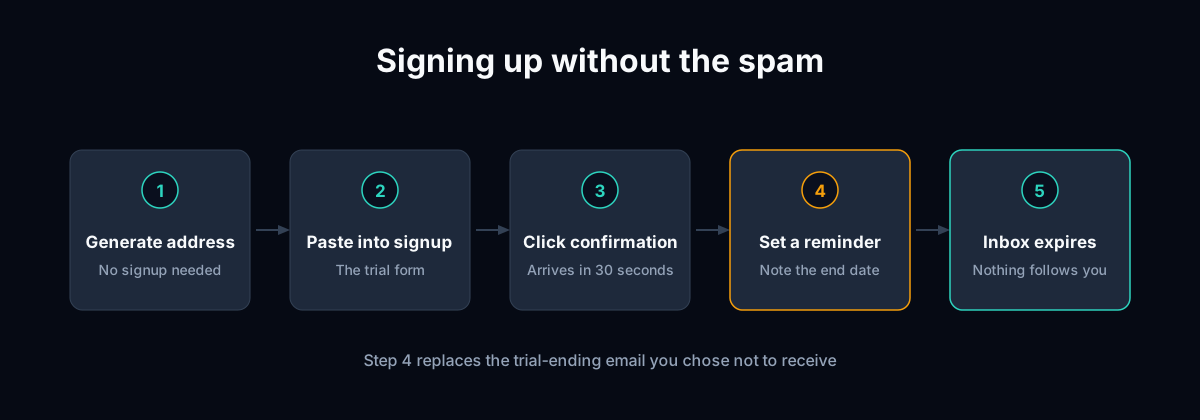
Step 1: Generate an address. Open VanishInbox in a second tab. A working address appears the moment the page loads, with no account and no configuration. For a signup you want to handle in one sitting, the 10 minute email is the right tool: the inbox lives long enough to catch a confirmation and expires before anything else reaches it.
Step 2: Copy it. Hit the copy button next to the generated address. Leave the tab open.
Step 3: Complete the signup. Paste the address into the trial form and fill in the rest as normal. If the form asks for a card, read the section on cancellation below before you enter one.
Step 4: Collect the confirmation. Switch back to your VanishInbox tab. The inbox refreshes on its own every few seconds, and most confirmation emails land inside 30 seconds. Click the verification link or copy the code straight from the message.
Step 5: Set a reminder before you close the tab. Work out the trial end date and put it in your calendar now, while the detail is in front of you. Count the trial length forward from today and set the reminder two days short of it. This step replaces the reminder email you have chosen not to receive, and skipping it is where most people get caught.
Step 6: Use the trial. The account is active. The inbox expires and takes the welcome sequence with it.
For a longer walkthrough of the verification step itself, including what to do when a code arrives late, see how to use a temporary email address for verification.
The Trial-Ending Reminder Problem
A 10-minute inbox is gone well before the "your trial ends in three days" email arrives. That is the point of the tool, and it is also the one real trade-off. You have traded the marketing emails and the reminder emails together, because they arrive through the same channel.
Two ways to handle it, depending on what you want from the service.
If you are testing and expect to walk away, your calendar reminder is enough. Set it for two days before the trial ends, with the cancellation URL in the event description. Cancel from inside the account, not from an email link.
If you think you might keep the service, swap your address in account settings once you have decided. Nearly every SaaS product lets you change the account email from a settings page, and the change takes effect immediately. You get the trial reminders, the receipts, and the password recovery route, and the company gets your real address only after it has earned the relationship. The welcome sequence already fired into an inbox that no longer exists.
The order matters here. Signing up with a disposable address and upgrading to your real one afterwards gives you the full trial on your own terms. Signing up with your real address and trying to clean up later gives you an entry in a marketing database that no unsubscribe link removes from the broker ecosystem downstream.
Trials Where a Disposable Address Is the Wrong Choice
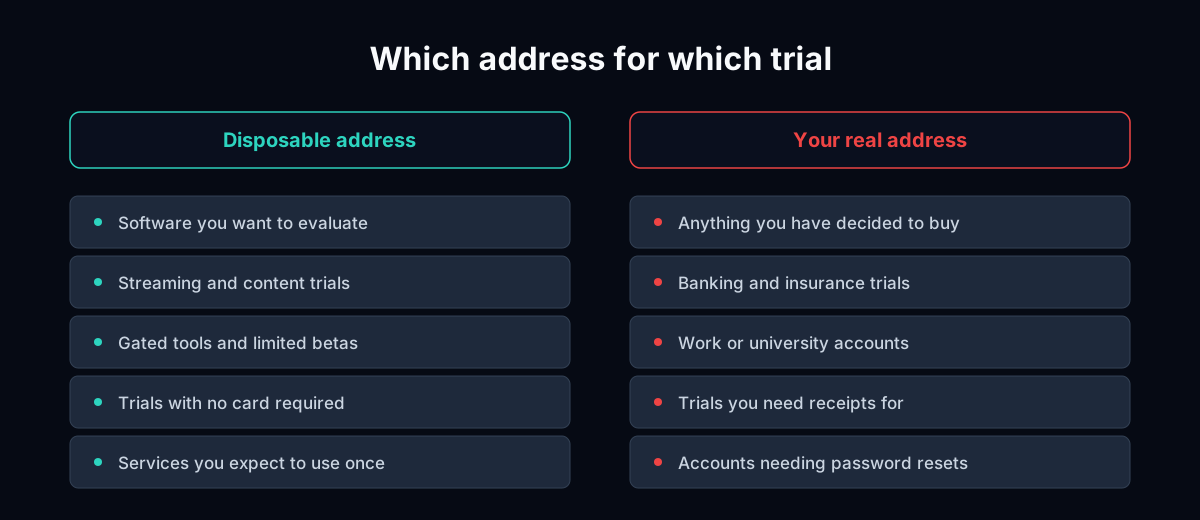
Being straight about this: the tool fits some trials and not others.
| Use a disposable address | Use your real address |
|---|---|
| Software you want to evaluate for a week | Anything you have already decided to buy |
| Streaming and content trials | Banking, investment, and insurance trials |
| Gated tools and limited-access betas | Anything tied to your employer or studies |
| Trials with no card required | Trials where you will need receipts for expenses |
| Services you expect to use once | Accounts you will need to recover a password for |
The dividing line is permanence. A disposable inbox cannot receive a password reset in six months, because it will not exist in six months. If losing access to the account would cost you money or time, the account needs an address you control permanently.
This maps onto a broader filter that works for every form you fill in, not only trials: real address for people and services you would give your phone number to, disposable address for everything else. One rule keeps your inbox clean sets out the full framework and the grey areas it handles.
Cancelling Before You Get Charged
Most people who search for a way to avoid trial spam are also worried about the charge, so it is worth separating the two clearly. A disposable email address does nothing about a card on file. The payment method and the email address are stored in different places and do different jobs.
If a trial required a card, treat the cancellation as the main task and the email as housekeeping.
Check how the trial ends before you start it. Some trials expire and lock you out. Others convert to a paid plan on day 15 without asking. The signup page usually says which, in smaller type near the card field. A trial that takes a card and says nothing about conversion is converting.
Cancel from inside the account. Go to billing settings and cancel there. Do not rely on a cancellation link from an email, and do not cancel by replying to a message, because a disposable inbox cannot send.
Keep the confirmation. Screenshot the cancellation screen and note the date. If a charge appears anyway, that screenshot is what you send to your card provider.
Cancel early, not on the last day. Billing systems run on their own clock and a cancellation processed on the final day sometimes lands after the renewal. Two days of margin costs you nothing.
Readers in the UK and the EU have one more option if a charge does go through. The Consumer Contracts Regulations give you a 14-day cooling-off period on most contracts agreed at a distance, counted from the day the contract is concluded, which for a converted trial is the day the paid subscription starts. The right has exceptions, and a service you have already used in that window may be charged pro rata for what you consumed. Your card provider's chargeback process sits behind that as a backstop if the company refuses to engage.
When a Trial Signup Rejects Your Address
Some platforms run blocklists of known disposable domains. The signup form returns something along the lines of "please enter a valid email address" or refuses the submission with no explanation.
The fix is a different domain. VanishInbox offers five: fommie.com, whoopza.org, fommie.online, fommie.store, and whoopza.store. Pick another from the dropdown and submit again. Newer and lower-volume domains appear on fewer blocklists, so the second attempt usually works.
SaaS trials block disposable addresses more often than content sites do, because the trial itself has a cost they want to meter per person. If every domain is refused, your fallback is a secondary personal address kept for lower-trust signups, not your primary inbox.
Why websites reject temp email covers the detection methods in detail, including the difference between a static domain blocklist and live MX-record checks.
Putting It Together
The trial you want and the email you do not want arrive through the same form, and a disposable address separates them. You get the fourteen days, the company gets a verified inbox that expires, and your real address stays out of a database you have no control over.
Three things make the difference between a clean trial and a messy one. Generate the address before you start the signup. Put the end date in your calendar while you are still on the page. Cancel from inside the account if a card is involved, with a couple of days to spare.
Everything after that takes care of itself, because there is nothing left to unsubscribe from.
Generate a free disposable address →
Frequently Asked Questions
Can I use a temporary email for a free trial that requires a credit card?
Yes, and the two are unrelated. The email address determines where the company's messages go. The card determines whether you get charged when the trial converts. A disposable address works fine on a card-required trial, but you still need to cancel inside the account before the renewal date. Set the calendar reminder at signup, because the trial-ending email will arrive after the inbox has expired.
Will the company know my email address is disposable?
Some will. Larger platforms check incoming addresses against blocklists of known disposable domains, and a handful run live checks on the mail server behind the domain. If a signup form refuses your address, switch to a different domain from the dropdown and try again. Nothing happens retroactively: once an account is verified and active, services do not go back and audit the address you used.
What if I decide to keep the service after the trial?
Change the account email in settings. Every subscription service lets you do this, and it takes a minute. Do it before the trial ends so that your receipts, renewal notices, and password recovery route all point at an inbox you still have. You keep the account and the history, and the marketing sequence that fired during the trial went to an address that no longer exists.
Can I use disposable addresses to get the same free trial more than once?
Most services prohibit this in their terms, and they detect it through the payment method, the device, and the IP address long before the email address comes into it. A second trial on the same card usually gets refused outright. This guide is about taking one trial without the marketing that follows, which is a different thing from taking a trial twice.
Does a disposable email stop me being charged?
No. Nothing about the email address touches the billing system. If you gave a card, the subscription converts on schedule whether the confirmation email reached a permanent inbox or a temporary one. Cancel in the account's billing settings and screenshot the confirmation.
How long do I have to grab the confirmation email?
Ten minutes with a VanishInbox address, which is far longer than it takes. Confirmation emails from trial signups usually arrive within 30 seconds, and the inbox refreshes on its own while you wait. If nothing has landed after a minute, check that the signup completed and that you pasted the address without a trailing space, then generate a fresh address and try again.
Is using a temporary email for a free trial legal?
Yes. You are providing a working email address that receives mail and verifies your account, which is what the form asked for. No law requires you to hand a company an address you intend to keep. Individual services can set their own terms about disposable addresses, and the consequence of breaching those terms is a refused signup, not a legal one.


