You've been careful. You only subscribe to newsletters you want: a finance digest, a tech roundup, a cooking blog you read every week. You didn't sign up for anything sketchy. You made considered choices.
So why is your inbox getting noisier anyway?
"Free" newsletters come with costs that aren't listed anywhere on the sign-up page. Your attention, your data, and your email address itself are all part of the deal, whether you knew that or not.
What You're Paying With
When a newsletter is free to read, someone is still paying for the infrastructure, the writer's time, and the platform fees. That money comes from somewhere. Usually, it comes from you, not from your wallet.
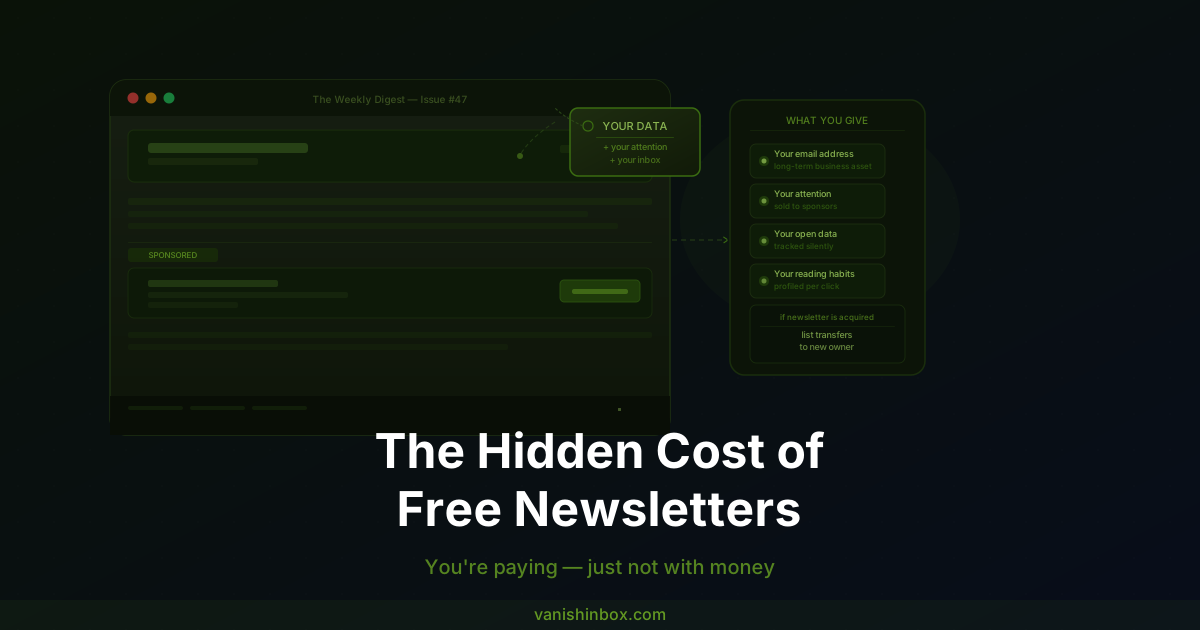
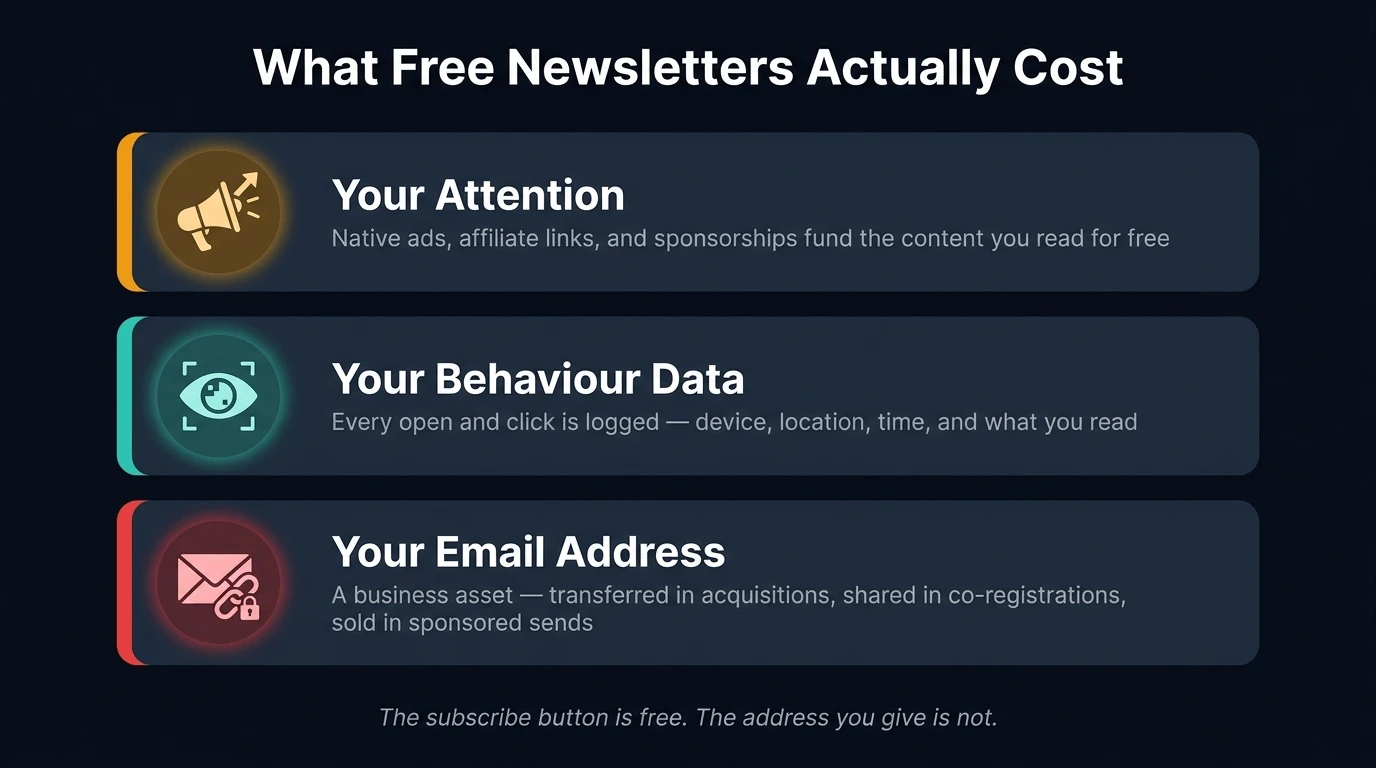
There are three currencies most free newsletters collect: your attention, your behavioural data, and your email address as a long-term asset. Understanding each one changes how you think about the subscribe button.
Cost 1: Your Attention Has a Price Tag
The most visible cost is also the most accepted one. Newsletters that are free to read are almost always funded by advertising, sponsorships, or affiliate commissions, and that's not inherently a problem.
Here's what that looks like in practice.
Native ads are written to match the newsletter's editorial voice, which makes them harder to identify as paid content. Sponsored sections promote products the writer may or may not personally use. "Recommended" links are frequently affiliate links, and the newsletter earns a commission if you buy. Job boards, tool directories, and "partners" sections are often paid placements dressed up as curation.
None of this is illegal or even unusual. But it means the newsletter you trust for recommendations has a financial relationship with some of those recommendations. The content isn't purely editorial. Part of it is a vehicle for someone else's marketing budget.
Again, this is how most media has always worked. The difference is that newsletters feel personal and direct in a way that a magazine ad doesn't, which makes the blurring of editorial and commercial content easier to miss.
Cost 2: Every Open Is Tracked
This cost is less visible and more consequential.
The overwhelming majority of marketing newsletters, including the ones from thoughtful independent writers, contain tracking pixels embedded in the email HTML. When you open the newsletter, that pixel fires and reports back to the sender. What gets logged: whether you opened it, when you opened it, what device you used, and your approximate location via IP address.
This is standard practice across every major newsletter platform. It's how writers prove their audience value to sponsors: "My list has 40,000 subscribers with a 48% average open rate, mostly opening on mobile between 7 and 9am." That data comes from tracking you, and every subscriber like you, on every send.
The tracking doesn't stop at opens. Every link inside a newsletter routes through a redirect URL that logs the click before bouncing you to the destination. The writer knows which stories you read, which products you clicked, and how many times.
For a deeper look at how this tracking works technically, see how companies track you through your email. The mechanics are the same whether the sender is a brand or an independent newsletter.
This engagement data has value beyond proving audience size. It flows into newsletter platforms' own analytics products. It informs ad targeting within those platforms. And in some cases, it's used to segment subscribers for sale to sponsors: "engaged readers in the 25–44 age bracket who clicked finance content" is a more valuable audience segment than raw subscriber counts.
Cost 3: Your Email Address Is a Business Asset
This is the cost most people don't see coming, and the one with the longest tail.
When you subscribe to a newsletter, your email address doesn't just sit in a list. It becomes part of the newsletter's subscriber base, which is one of its most valuable business assets.
Newsletters get acquired. The independent finance writer you've been reading for three years gets bought by a media company. The cooking blog joins a content network. The tech roundup is acquired by a larger publisher. This happens all the time; newsletter acquisitions are a significant part of the media industry.
When a newsletter is acquired, the subscriber list transfers with it. You subscribed to one writer's independent newsletter. You now belong to a corporate email list, governed by a different privacy policy, potentially operated by people with different values around data. You may not even be notified. The first sign might be a changed tone, more ads, or emails from brands you don't recognise.
Co-registration is more common than you think. Some newsletters embed sponsor opt-ins directly into their sign-up flow. A pre-ticked checkbox reading "I'd also like to receive offers from [Sponsor Name]" means subscribing to the newsletter also subscribes you to the sponsor's list. Sometimes this checkbox isn't pre-ticked but is still easy to miss. You came to subscribe to one newsletter; you left subscribed to two or three things.
Some newsletters explicitly sell list access. Certain newsletter operators sell sponsored sends, where a brand pays to have a standalone email sent to the entire subscriber list. Your address is the product being sold, for that send. The newsletter's privacy policy may permit this under language like "selected third-party partners," the same boilerplate that appears in most sign-up flows.
Your careful, considered subscription to a newsletter you trust can still end up somewhere you never intended, through an acquisition, a co-registration, or a sponsored send. This is one of the less obvious ways spam from companies you've never heard of finds its way into an inbox that was never carelessly managed.
The Signs a Newsletter Is Treating Your Address as a Commodity
Not every newsletter behaves this way. Many independent writers are careful about their subscribers' data and transparent about how they make money. But there are red flags worth knowing.
| Red flag | What it might mean |
|---|---|
| Pre-ticked sponsor opt-ins on sign-up | Co-registration, you're subscribing to more than one list |
| "Partners" or "vetted brands" in privacy policy | List access may be sold or shared |
| Sudden increase in sponsored content after months of clean editorial | Monetisation model changed, often post-acquisition |
| Emails from unfamiliar brands shortly after a new newsletter subscription | Co-registration or sponsor send included your address |
| Newsletter "joins a network" or announces an acquisition | Subscriber list is transferring to new ownership |
| Quality or tone shift with no explanation | Editorial control has changed hands |
It's also worth checking which platform the newsletter runs on. Substack, Beehiiv, ConvertKit, and Mailchimp each have their own data policies layered on top of the newsletter operator's. When you subscribe to a Beehiiv newsletter, for example, you're also subject to Beehiiv's terms, which govern how subscriber data is handled at the platform level, separate from what the writer does with it.
How to Subscribe to Newsletters Without the Risk
The goal isn't to stop reading newsletters. Plenty are worth your time. The goal is to subscribe in a way that limits what you hand over before you've decided a newsletter has earned it.
Newsletters you deeply trust and have read for a long time are worth your real email address. You've already decided the relationship is valuable and the writer is careful. Subscribe directly.
Newsletters you want to try but aren't sure about call for a secondary email address. Not your primary inbox, but a Gmail or Proton account you maintain specifically for lower-trust subscriptions. If the newsletter earns your trust over time, update your address in account settings. If it doesn't, the noise stays contained.
Newsletters you want to sample once before committing are where a disposable address earns its place. Generate a temporary address with VanishInbox, subscribe, and see what arrives. Does the first email match what was promised? Is the writing worth reading? Are there sponsor opt-ins buried in the welcome message you didn't notice on the sign-up page?
If the newsletter passes the test, subscribe again with your real address. If it doesn't, the disposable address expires and nothing follows you out.
Testing this way isn't about distrust. It's about establishing trust before handing over something permanent. Your real email address is a long-term commitment. A disposable address lets you try before you decide.
For a broader framework on which services deserve your real address and which don't, one rule covers the full picture.
Putting It Together
Free newsletters have real value. The best ones are well worth reading, and the writers behind them deserve to build sustainable businesses. But "free" is a framing, not a fact. Every newsletter subscription is an exchange, and it helps to know what you're exchanging.
Your attention funds the content through advertising. Your behaviour data proves the audience's value to sponsors. And your email address enters a system that may outlast the writer who originally asked for it, through acquisitions, platform policies, and co-registration agreements you didn't fully read.
Subscribing smarter doesn't mean subscribing less. It means testing with a disposable address, graduating to your real one when a newsletter earns it, and knowing the red flags that signal your address is being treated as inventory rather than a relationship.
Generate a free disposable address →
Frequently Asked Questions
Do free newsletters sell your email address?
Some do, some don't, and most privacy policies are written to permit it without saying so plainly. Language like "sharing with selected partners" or "working with trusted third parties" typically covers list sharing and sponsored sends. The safest assumption when subscribing to any newsletter you don't already know well is that your address may eventually reach parties beyond the original sender.
What happens to my email when a newsletter is sold or acquired?
The subscriber list transfers as a business asset. In most cases, subscribers are not asked to opt in again under the new owner; the original sign-up is treated as sufficient consent. You may receive an email announcing the change, but you're rarely given a clear opt-out before the transfer happens. This is one of the most significant ways a trusted subscription can become a source of unwanted email without you having done anything differently.
Is Substack safe for my email privacy?
Substack handles subscriber data at the platform level, meaning your email is stored in Substack's systems, not just the individual writer's. Substack's privacy policy governs what happens to that data across all newsletters on the platform. The individual writer cannot necessarily control what Substack does with aggregate subscriber data. If you're concerned about platform-level data handling, subscribing with a secondary or disposable address limits your exposure.
Can I unsubscribe from a newsletter and have my data deleted?
Under GDPR in the UK and EU, you have the right to request deletion of your personal data. Unsubscribing removes you from the mailing list but does not automatically trigger data deletion. You'd need to submit a separate deletion request, typically via the newsletter platform's privacy settings or a direct email to the operator. In practice, many smaller newsletter operators don't have a clean deletion process. Your address may remain in their database even after you've unsubscribed.
What's the difference between a newsletter and spam?
A newsletter is email you consented to receive: you subscribed, confirmed your address, and opted in. Spam is unsolicited email sent without your consent. In practice, the line blurs when newsletters engage in co-registration (adding you to third-party lists you didn't explicitly choose), when newsletters are acquired and the new owner sends content you'd never have signed up for, or when unsubscribing doesn't result in actual removal. Consented email that you no longer want, and can't easily stop, occupies a grey area that feels like spam even if it technically isn't.