A SaaS founder runs the numbers on a slow Tuesday. Their free trial is converting at 4%. Industry average is 12%. They dig into the sign-up data and find that 19% of their trial accounts were created with disposable email addresses. Not one is reachable. Not one has opened a single email. Not one has any intention of paying.
That's the company's perspective. And it's a legitimate grievance.
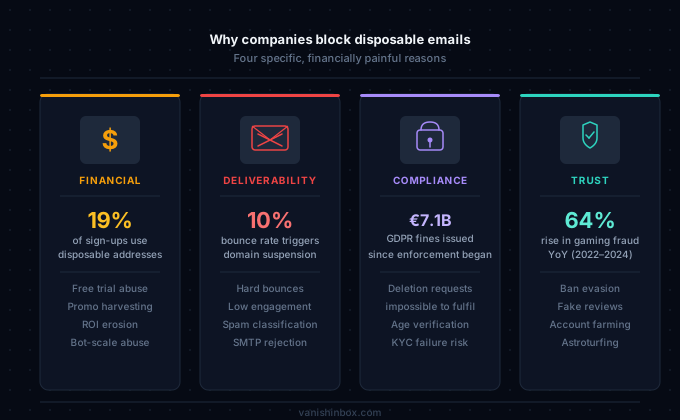
Companies block disposable emails for real, specific, financially painful reasons, not paranoia. At the same time, users reach for disposable addresses in direct response to how companies have treated their data for the past two decades. Both sides are reacting to behaviour that earned the reaction.
This guide covers what companies are actually losing, where their blocking logic goes too far, and how to think about when a disposable address is the right call.
Reason 1: Free Trial and Promotion Abuse
The most acute pain point is money.
Services that offer free trials, sign-up bonuses, referral credits, or first-order discounts typically tie those offers to an email address, one per person. A disposable email lets a single person spin up unlimited addresses, claiming the offer each time. At small scale, this is a nuisance. At bot scale, it becomes a serious financial drain.
Bots now account for 46% of all online sign-ups, and many are built specifically for promotional harvesting. In retail, one study found fake sign-ups outnumbered real ones 120:1 on some platforms. The SaaS equivalent is a user who runs an unlimited trial indefinitely by creating a new account every 14 days, systematically extracting value the company built for paying customers.
The arithmetic on email ROI makes this hurt more than it looks. Email marketing returns around $36 for every $1 spent, one of the highest-performing channels in a company's stack. A list full of non-functional addresses quietly erodes that ratio. Every campaign sent to a dead inbox is money spent on a guaranteed zero-response recipient.
For subscription businesses in particular, disposable emails also break lifecycle marketing entirely. Welcome sequences, onboarding drips, upgrade nudges, and win-back campaigns all rely on the email address working for months, not minutes.
Reason 2: It Destroys Email Deliverability
The technical damage is less obvious but more widespread.
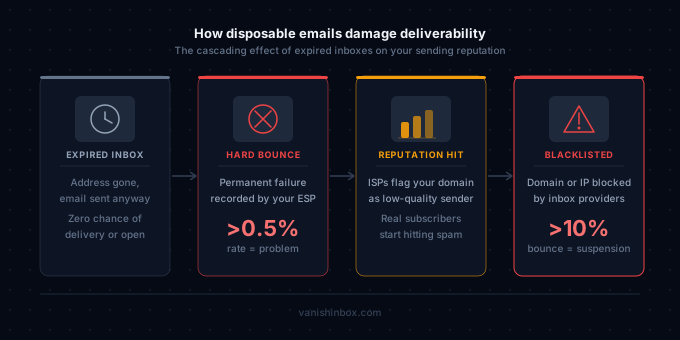
When a disposable address expires and you send to it, the message bounces. Enough bounces and email service providers, Gmail, Outlook, Yahoo, start treating your sending domain as a problem. A healthy hard bounce rate sits below 0.5%. Above 10%, you risk suspension. Your entire domain can end up flagged as a spam source, meaning even your legitimate emails to real customers start landing in junk folders.
In 2024, 9% of all email subscribers unsubscribed and a further 7% became non-deliverable from bouncing. That's 16% annual list erosion before a single disposable address enters the picture. Add even a modest disposable contamination rate and engagement metrics collapse. ISPs read low open rates as a signal that recipients don't want your email, which is often exactly right, but the algorithmic response punishes you across your entire list.
Gmail tightened this further in late 2025, moving from an educational phase to active enforcement of SPF, DKIM, and DMARC authentication requirements. Emails failing these checks now get rejected at the SMTP level rather than routed to spam. Many disposable email services hadn't implemented proper authentication infrastructure, so their domains started failing these checks. Legitimate senders with poor list hygiene fared no better.
The broader point: companies blocking disposable addresses aren't just protecting their marketing campaigns. They're trying to stop their entire sending reputation from degrading.
Reason 3: Compliance Becomes Impossible
Companies rarely talk about this one publicly, but it drives significant policy decisions.
GDPR gives any EU resident the right to request deletion of their data from a company's systems. The company must respond within 30 days. California's CCPA grants similar rights, with fines up to $7,988 per intentional violation. Eight new US state privacy laws took effect in 2025. GDPR enforcement alone has accumulated €7.1 billion in fines since it began.
A disposable email that expires makes identity verification for these requests structurally impossible. To honour a deletion request, a company typically sends a confirmation to the email on file. If the inbox no longer exists, the loop can't close. The company can't confirm the request came from the account owner, can't complete the process, and technically remains in violation of the regulation through no fault of their own.
Age verification laws create a parallel problem. The UK's Online Safety Act, for example, requires platforms to verify that users are old enough to access certain content. Disposable emails bypass verification systems built to satisfy this requirement, creating regulatory liability for the platform.
In fintech specifically, know-your-customer (KYC) requirements mean disposable email usage correlates with fraud rates exceeding 70% in some sectors. Regulatory auditors treat a high disposable-email rate in a user database as a fraud signal in itself.
Reason 4: Accountability and Platform Integrity
Online marketplaces, gaming platforms, forums, and community sites depend on a thread of accountability between a real person and their account. A permanent email address is an imperfect version of that thread, but it's meaningful.
Disposable emails cut the thread. Someone banned from a gaming platform creates a new account in thirty seconds. A seller who receives negative reviews on a marketplace abandons the account and starts again. A forum troll evades moderation indefinitely by rotating addresses.
The gaming and iGaming sectors saw fraud increase 64% year-on-year between 2022 and 2024, with disposable emails cited as a primary enabler of account farming and review manipulation. Marketplaces that depend on user reputation, stars, reviews, transaction histories, find that disposable-email-created accounts undermine those trust signals systematically.
This reason carries the most moral weight for blocking, and it's also the one most frequently used as cover for more aggressive restrictions. "Platform integrity" is a genuine concern. It's also a convenient justification for blocking tools that simply make user tracking harder.
What Companies Don't Acknowledge
Every one of those four reasons is real. None of them is the full picture.
Companies created the conditions that made disposable email necessary, and users are reaching for it in response.
For twenty years, companies collected email addresses, sold them to third-party brokers, and used them to build advertising profiles without meaningful consent. Data breaches exposed hundreds of millions of addresses. Marketing platforms used email as a vector for surveillance, tracking which links you clicked, when you opened messages, where you were when you did it, and linking that data to browsing behaviour across the web.
The disposable email market is now worth $375 million annually. That figure represents users voting with their behaviour for an alternative to the system as it exists.
Apple recognised this. Hide My Email, part of iCloud+, generates anonymous forwarding addresses so users can sign up for services without exposing their primary inbox. These addresses look like normal iCloud addresses and behave like them: mail forwards through, replies work, but the underlying identity stays shielded. In June 2026, Apple announced it would move these addresses to the @private.icloud.com domain, making them identifiable. Companies can now detect and block them specifically. Apple's privacy feature has become an arms-race casualty.
The Discord case from 2025 illustrates where aggressive identity verification leads. The UK's Online Safety Act required Discord to collect government-issued ID photos for age verification. The resulting database became a target: millions of identity documents in one place, collected in the name of protecting users. The "solution" to anonymous sign-ups created a breach risk far larger than the problem it solved.
There are also legitimate use cases that blocking policies routinely catch as collateral damage: developers testing registration flows, researchers who need to avoid tracking across services, people in abusive situations who need anonymity for physical safety, and anyone trying a service before they're ready to trust it with their primary address. A user testing your product before handing over their real email is a potential customer exercising reasonable caution, not an enemy.
The companies that treat every disposable address as a fraud signal lose those people. The ones who understand why users behave this way tend to earn the address eventually.
Where to Use a Disposable Email (And Where Not To)
The right framework is simple: use your real address where losing access to the account would genuinely cost you something.
Stick with your real email for: banking and investment accounts, healthcare portals, government services, accounts where money or legal records are involved, and anywhere you'd need reliable account recovery. These services need to reach you, and you need to be able to reach them. Breaking that connection creates real problems.
A disposable address is the right call for: reading a gated article or downloading a PDF, testing a SaaS product before you commit to it, entering a raffle or competition, responding to a one-off event RSVP on an unfamiliar platform, and any form on a site you found through a cold email or ad.
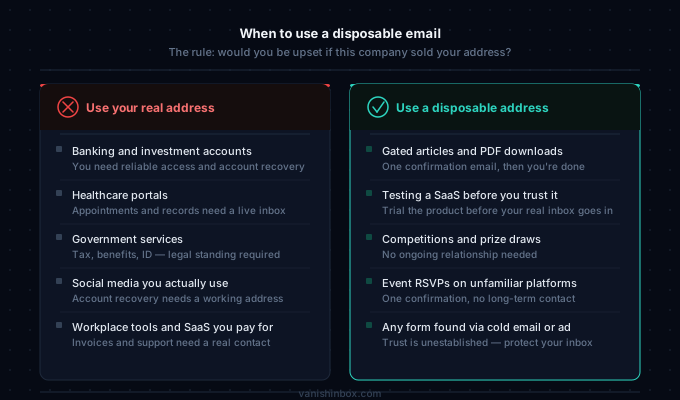
The heuristic is straightforward: if you'd be upset to discover the company sold your email address, use a disposable one.
VanishInbox generates a working inbox in seconds. No account required, nothing stored. Use it to receive the confirmation email, download the resource, or complete the sign-up, then it's gone. Your primary address never appears in that company's database, which means it's not in the breach when that database leaks.
For a broader look at how email addresses get bought and sold between companies, see what actually happens when a website sells your email address.
The Actual Problem Companies Should Be Solving
Blocking disposable emails is a symptom-level response to a trust-level problem.
The companies facing the highest rates of disposable-email abuse are almost always the ones whose value proposition hasn't yet earned users' real address. Someone who wants to use your product for the long term hands over a real inbox, because they need you to be able to reach them. The ones using throwaway addresses are signalling something: they want what you're offering, but they don't trust you yet.
Aggressive blocking closes off that path. The user who was testing you with a disposable address bounces. The policy designed to protect against fraud captures a legitimate prospect as collateral.
The arms race continues in one direction: more sophisticated detection, more sophisticated circumvention, repeat. Apple's move with @private.icloud.com shows the terrain is changing. Privacy-protective email tools are now mainstream consumer expectations, not niche hacker workarounds. Blocking harder doesn't change that expectation. It only frustrates the people who hold it.
The alternative is earning enough trust that users hand over their primary address because they want to, not because they're forced to.
Frequently Asked Questions
Do companies have the right to block disposable emails?
Yes. A company can require any type of email address as a condition of using its service. Whether blocking is the right policy decision for their specific situation is a separate question from whether they're permitted to do it. The flip side of that same question, whether using a disposable address in the first place is legal for the user, has a clear answer too: see is it legal to use a temp email address? for the case law behind it.
Will using a disposable email get my account banned?
On services that actively detect and block them, your sign-up will fail. Some services allow sign-up with a disposable address but later suspend accounts when the address bounces or is flagged in a detection pass. For services where you intend to maintain a long-term account, use your real address.
Is Apple's Hide My Email the same as a disposable email?
The function is similar, since both shield your real address, but the mechanism differs. Hide My Email creates a forwarding address that stays active indefinitely and delivers mail to your real inbox. VanishInbox and similar disposable services provide a temporary inbox that expires. After Apple's June 2026 announcement, Hide My Email addresses at @private.icloud.com are now identifiable and blockable by companies that choose to filter them.
Can companies tell if I'm using a disposable email?
Yes, more and more. Commercial detection services maintain databases of known disposable email domains, updated on a rolling basis: one major service adds between 5 and 20 new provider domains per day. DNS checks, MX record analysis, and behavioural signals (multiple sign-ups from the same IP) provide additional layers of detection beyond domain matching.
Does blocking disposable emails stop fraud?
Partly. It raises the cost and complexity for automated abuse. It doesn't stop determined bad actors, who can create real-looking Gmail or Outlook accounts for the same purpose; those aren't caught by domain-based detection at all. The security benefit is real but often overstated, particularly when weighed against the legitimate users caught as false positives.
If a phishing attempt arriving in your inbox prompted you to think about how your email address ended up in the attacker's hands, see how to spot a phishing email for a practical breakdown of the signs. For the full picture of reducing your exposure across all your accounts, how to protect your personal information online covers the rest.